Showing posts with label forgotten. Show all posts

Wednesday, 28 September 2011

Forgotten Corfu 12: The Blondel house in Garitsa, built on the site of a little known catholic monastery

  This neoclassical mansion in Georgian colonial style was built during the british protection by a british man named Blondel at the point where Marasli meets the coastal Mitropolitou Athanasiou street.
   Blondel built the villa in the middle of an exotic garden which had many kinds of trees and plants. He did not hesitate to plant quite a few weird trees of the citrus family (Rutaceae), native to Australia and non-edible. Two or three of these rare trees, remnants of Blondel gardens, are still being preserved in the Garitsa coastal park, just opposite the building. Some of the locals can remember students from the nearby high school (now moved to another site) playing with the massive yellow-green fruits. Corfu's lover, Felicity Baxter, indicated that these trees are unique throughout Europe. Two identical trees exist in the courtyard of the old British Government House in Gaios, Paxos. 


Detail from an 18th century map showing the monastery of S. Giustina 
  On the same site that Blondel's villa was built, the catholic monastery of Santa Giustina (Santa Gioustina) could be found. The monastery was built to honor Santa Giustina, whose memory is honored by the Western Church in October 7, the day when in 1571 the united christian fleet won the ottoman one in the battle of Nafpaktos (Lepanto). The monastery is being considered the oldest naval hospital after that founded in Livorno, Italy in 1570 and was used to hospitalise those who took part in the battle of Nafpaktos. 


The villa in the early 80s with the façade exposed
  Today the pink villa is squezed by the modern neighbouring apartment blocks, hiding its ornamental façade.


Friday, 15 April 2011

Corfu in detail 12: The so called "Juliet's balcony" in Campiello

  Somewhere inside the maze of Campiello old venetian alleys, on Ypapantis street, there is a balcony which somewhat resembles to the famous Verona one belonged to Juliet Capulet (in Italian Giulietta Capuleti). Few local people are aware of it's existence as it's off the beaten track. Ornate and made of stone, it stands out from the other common ones in the area. 


  Sadly, the owner of this balcony does not respect its unique beauty and placed a satellite disk on it. 


  If someday you pass by the area, look for it - it deserves a brief look. Its uniqueness can't be missed!


- Two old photos from the same balcony (courtesy of Corfu-Memories from the Past group on Facebook)


Saturday, 12 February 2011

Forgotten Corfu 11: The ruins of an old convent inside the Mon Repos estate

  Inside the famous Mon Repos estate, there are the relics of an old convent, probably dedicated to Agios Panteleimon. The complex is in a horrible state and needs to be restored as soon as possible. It seems to be about 300-400 years old, I looked up for some clues on internet but I couldn't find anything about it.


  The roof seems to have been long gone now and the interior of the church is completely exposed to the weather.


  The skillfully painted interior still survives although fainted.


  The traditional bell tower still stands having a pair of bells on it.


  A spring and a marble monument where probably candles had been placed can be found around the premises.


  Looking up above one of the church's entrances, a coat of arms carved on marble stands.


 The convent's facilities are in a sorry state as well.


  Even though the appaling state the convent is in, there are plenty of pleasant details to appreciate.


  Coming as a suprise, the ornamental recently vividly coloured plaque, which probably depict Virgin Mary and Joseph, makes a contrast with the grey weatherbeaten walls. 


  The convent can easily be found near the Mon Repos palace, on the wooded road to Kardaki. I heard that soon it will be restored with E.U. money which will revive this wonderful unknown religious site. Does any of you know some things about its history?
  

Sunday, 9 January 2011

Forgotten Corfu 10: A ditch in Garitsa (which probably is what is left from an ancient canal)

  Garitsa is one of the first suburbs of old Corfu Town. The area was first mentioned in the middle of 17th century as "Gastrades", a name taken from the small salted water ponds which were abundant there. The suburb was built on what was the cemetery of the ancient Corfu town. That town had two ports. One on Garitsa's gulf and a second, much bigger, on Yllaikos bay, the arm of sea on which the airport was built. Probably a canal provided communication between Garitsa and Yllaikos bays served as well as a defensive ditch. That canal existed up to the 18th-19th century as an old 18th century map below suggests.

An 18th century venetian map of Garitsa. The red arrows mark the canal while the red point notes its crossing with the future Cyprus street, point in which the modern ditch emerges.

  The red arrows point the location of the canal on the map. It's a thin black line which starts from the middle of Garitsa Bay and diverges on the upper part of the map. One branch, which looks like the wider one, seems to lead to Illaikos bay and the others to the Pagkrateika neighbourhood. The map also suggests that there had been only one bridge over the canal, on the high street of Garitsa (Alkinoou street), colloquially known as the "foro" (from the latin word "forum" - a public meeting place)
  Today little is known about its existence. Garitsa is now a dense neighbourhood of Corfu Town with plenty 60s-70s apartment blocks. The historic core around Alkinoou street still retains most of its old venetian buildings but the ancient canal no longer exists.
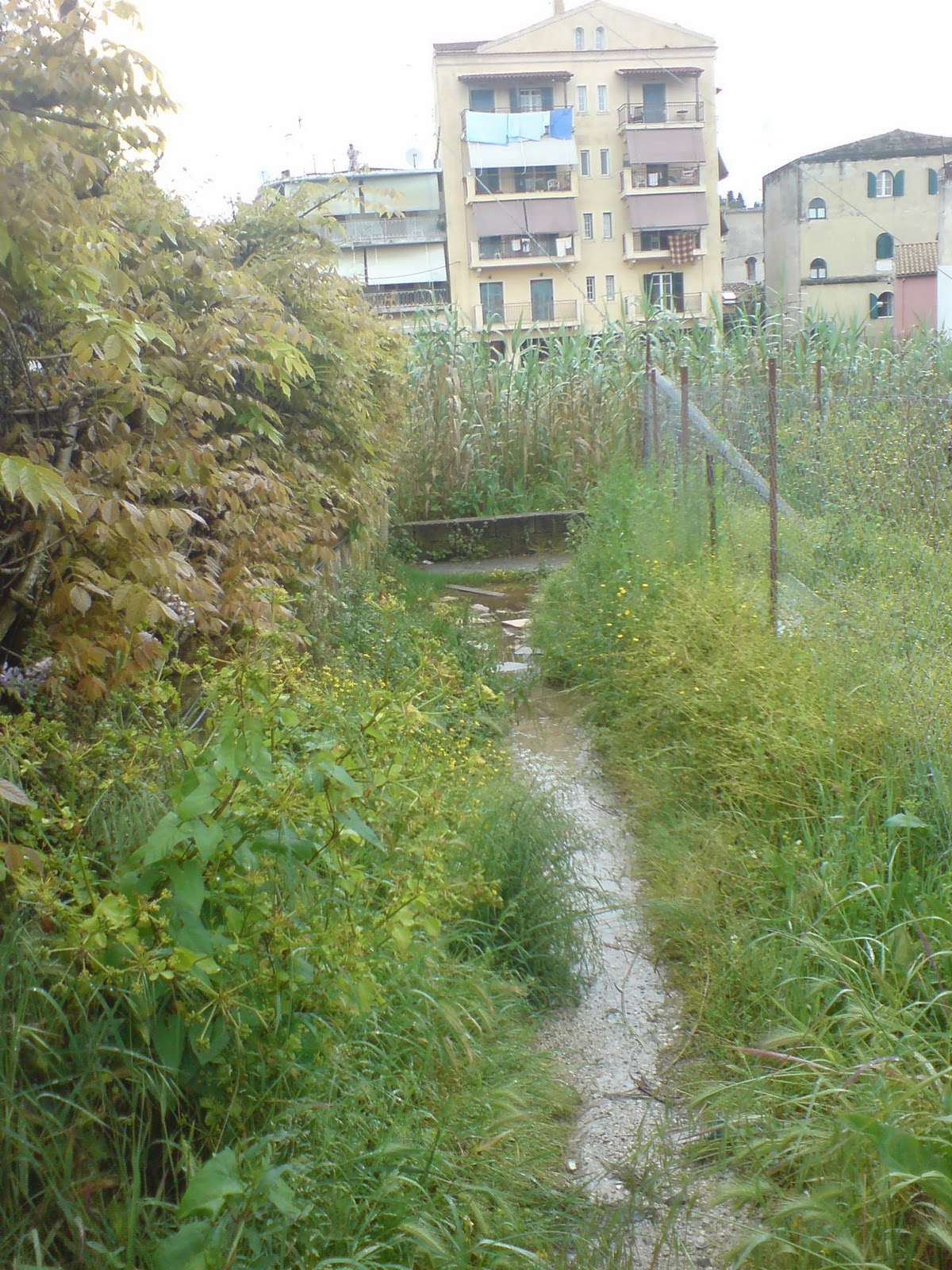
  I tried to find any proofs of its existence. The only thing I found which maybe is derived from the ancient canal, was a narrow ditch on the west side of Cyprus street which during winter is full of water.


 It looks actually more like an open sewer judging from the odour and the fact that it continues under the street and beyond as an underground sewer.


 It's western end, point in which becomes a sewer too, is near Georgaki street, the thoroughfare opposite the stadium. 
  
 There are many canes which take advantage of the moisture provided by the ditch.


  Ι will visit the place again in the near future in search of further evidence of the ancient canal and investigate possible links with the ditch in Kotsela area.

Sunday, 24 October 2010

Forgotten Corfu 9: An ancient wall in Garitsa

  In the suburb of Garitsa I recently spotted an ancient wall in the juction of Cyprus and Kolokotroni streets. This wall follows the sharp ascenting Kolokotroni street and it almost encircles a detached house with a garden. The house seems to had been built much later than the wall itself and this can be proved by a 1910 documentary photo that I found in the Old Corfu Photos group in Facebook (see below).
  A special feature that makes the wall even more like an enigma is that it seems like a defensive one, like those which encircle fortresses or towns. Holes on the wall look like they had created on purpose. 
  The question is why. Did that wall protected an important structure during the venetian era? Had been part of some kind of fortification? Maybe, because the Salvatore fort (where now the prison stands) was not very far from the site. Or was just to decorate the peripheric wall of an ancient house? The 1910 picture gives no clue about that, it seems that the site behind the wall was just fields. 
  Look at the pictures I took the day before and compare them to the 1910 one. How built up and busy looks the area now and how serene and rural looked exactly one century ago.


- 1910 photo of Cyprus and Kolokotroni junction taken from "Old Corfu photos" group, courtesy of Zohios - Tzikas archives.

  - Another forgotten spot on Cyprus street, just 150 metres away from the wall: the Cyprus street commemorative post.

Monday, 11 October 2010

Forgotten Corfu 8: Τhe Cobici townhouse and its ornate door

  In the Venetian period existed families of merchants and nobility which were distinguished from the lower classes. They enjoyed a number of privileges and they had enough money to build grand houses to live in. One of them, still standing at Nikiforou Theotoki street oposite the St. Vasileios church is the Cobici townhouse. A tall five-storey building with vaults on the first floor, it dominates one of the busiest streets of old town.


It was build in 1680s by the cretan merchant family of Cobici. Being wealthy and powerful due to its involvement with shipping and sea trade, became one of the most important exporters of corfiot oil to Venice. The oldest reference of the family which has survived was from 1666 when Daniel Cobici was already trading oil in Corfu but his brother Nicolas, an oil trader too, was still back in Rethimno, Crete. When Crete fell to the Turks in 1668, Nicolas Cobici moved to Corfu and in 1699 the whole of his family joined him. The Cobici townhouse was not the only property which belonged to them. They had a farmhouse in the Lichaidoura village (which later was renamed Kompitsi after the family).

The former entrance of building can be found on a sidestreet, named after Bizi's family which had built their grand house there as well. Thus the narrow old lane has been known as "Το καντούνι του Μπίζη" ("Bizi's lane) since the venetian era. The entrance is quite ornate and it leads now to a fashionable hair salon.


A gargoyle head like a lion stands above the door while right above it a commemorative writing reads:

DANIEL . COBICI . MDCLXXX
RINOVATO . DEL 1728
(Daniel Cobici 1680 renovated in 1728)

  A pine cone at the very top, probably a symbol of the Cobici family is the "corona" of this artistic door. 


  At this point, I should notice that in the past I have posted photographs of these gargoyle heads which ornate the front face of the building. Click on the link to see them: http://johncorfuworld.blogspot.com/2009/03/ancient-sculptured-heads-on-old.html

  Being recently renovated, this grand old venetian building, which was in a derelict state prior its renovation, makes a strong presence among the neighbouring buildings and should more grey old buildings follow suit.


Friday, 8 October 2010

How does the interior of the Annunziata's monument looks like?

  Have you ever wondered how does the interior of a deteriorating venetian monument look like? Few days ago a user from the "Save Annunziata" group in Facebook had uploaded some photos taken in the interior of the monumental venetian campanile. I don't know how did he gained access as it is too difficult to find an entrance, and if you find one it will probably be locked.

  
As you can see in those exclusive documentary images, the interior is no way better than the exterior. Being a pigeon nest, rotten wood could be found everywhere ready to fall apart. 


Hopefully, the interior will be renovated as well and the good news are that it will be open to the public. It will be used as a viewing gallery with views towards the high streets of Eugeniou Voulgareos and Ioannou Theotoki.

Wednesday, 6 October 2010

The Annunziata renovation plans and the future cenotaph

  Following last month's protest, images of future renovatated Annunziata monument were published. The renovation plan involve the full renovation of the old but significant venetian campanile, a brand new cenotaph dedicated to the dead Battle of Nafpaktos' soldiers and the public space right next to the monument will be branded as "Annunziata square". 
 Warm and cheerful mediterranean colours have been selected, emphasising and respecting the significance of such a monument. There will be a poster which will inform the tourists and the locals about its history and a new lighting scheme will be implemented. 
  . 

  Hopefully by the end of the Annunziata's renovation, a new sight will be pinpointed on the tourist map, a must-see for those who love and appreciate the local and the european history

-Visit and support the "Save Annunziata" group in Facebook: http://www.facebook.com/group.php?gid=313723857937