Showing posts with label old. Show all posts

Wednesday, 24 October 2012

The Monastery of St. Theodore the Recruit and St. George Triumphant

  The Monastery of St. Theodore the Recruit and St. George Triumphant is the oldest (as regards the katholikon-main church) most important and most characteristic example of monastery architecture in Corfu. It combines an early christian basilica of the 5th century AD, the katholikon with the post-byzantine monastery architecture of 17th century which is typical of Corfu and the Ionian islands in general.


Αn early 19th century german map of Agioi Theodoroi area
  The katholikon was probably built in the 5th century as a three-aisled basilica with a narthex almost entirely out of materials from the nearby ancient greek temple of Artemis Gorgo. Access between the nave and the aisles (only the south aisle survives now) was through colonnades of piers, which are visible today inside the church and on the north facade. The large sermicircular sanctuary apse survives intact, as does the triple opening with relief crosses on the impost blocks of its colonnettes.


  It was probably in the Middle Byzantine period that the north aisle was lost, the colonnade was sealed up and the church was left with one only aisle and the nave. The present monastery complex was built in at least two phases between the 16th and the 18th century and it owned a considerable amount of property. The republican French, who succeeded the Venetians and occupied Corfu in 1797, seized the estate, closed the monastery down and installed a military garrison on the premises. In 1816 Sr. Thomas Maitland, British High Comissioner of the Ionian islands, repaired the monastery and restored it to its use as it is recorded by the relief inscription over the north entrance to the church. 


 During the Second World War the monastery was bombarded by the germans but it was restored by the nannies who lived there.


Monday, 8 October 2012

The Kolokotroni street detached houses

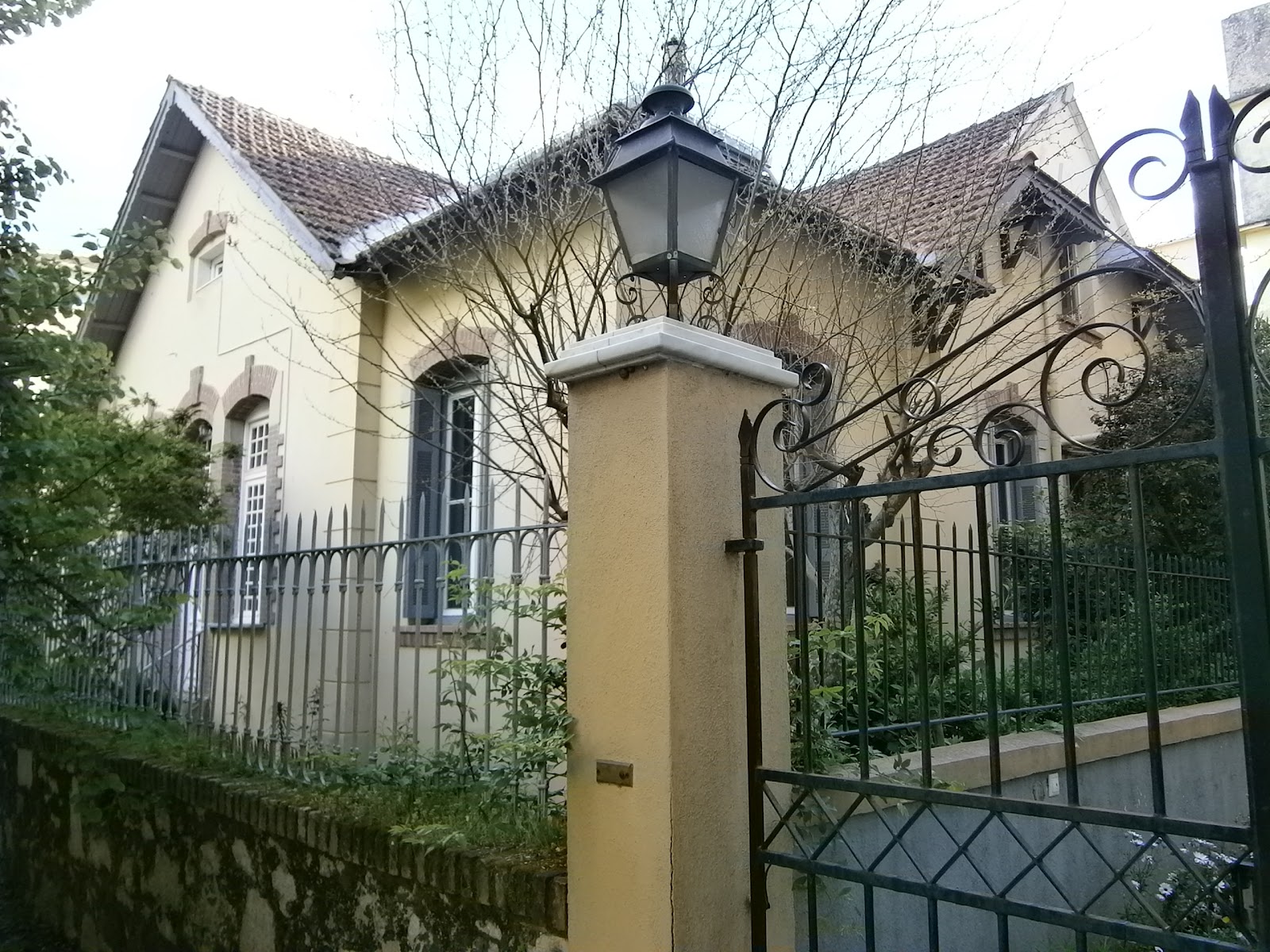
  Walking down Kolokotroni street from the prison towards the center of the town there is a row of some detached houses dating from early to mid 20th century. They are surrouded by small gardens and they look suburban despite being located less than 10 minutes walk from the busy Sarroko square.


]


  At the point where Kolokotroni street meets busier Methodiou and Donatou Dimoulitsa streets, there is an old building probably dating from 19th century. In the first floor there is a traditional mini-market owned by an ederly woman while the second floor is for residential use.


  I would really love to live in that neighbourhood because it is so close and far away at the same time from bustle and hustle of  Corfu town.

Sunday, 16 September 2012

Corfu then and now 11: The Spilia square

  Most of you have probably passed by the two pretty large squares in the old port area, where the new city marina is under construction. Well, before the 2nd WW bombings by the germans, the area was a major commercial centre bustling with activity. Many buildings and residences had been scattered around on what later became known as Spilia square. Among them, the famous "Markas" building, the town's old market building. 
  In the early 1800s engraving below you can see the Markas area looking towards east. In the centre of the engraving stands out the Markas building, which original façade and cupola looked lush. On the right, the old cereal storage building complex which survive up to our days and is home to the Agricultural bank. On the other side there were some residences which no longer exist.
  Which of the two images you prefer? It's a pity that the Markas building no longer exists, it would have been great to have it too standing in the middle of the square serving as the main town's farmer's market.

The area in which Spilia square is located today in the early 1800s.

The same view today...

Friday, 8 June 2012

How it looked like the medieval town of Corfu?

   Little is known about how the medieval town of Corfu looked liked before the completition of the complex 16th century venetian fortifications. There are few sources such as the map schetched by Konrad von Grünenberg in 1487, few decades before the completion of the Contrafossa canal which seperates the Old Fortress peninsula with the rest of Corfu Town. 
  In the map it is easily noticed that Contrafossa hadn't yet been constructed and most of town's residents lived inside the walled Old Fortress peninsula. Outside that walled area, there was Borgo, the then unwalled suburb. Few decades later Borgo became the central part of the town as many people had been forced to leave the fortress which became the administrative and military centre of the island. The port of the medieval town was at Mandraki, which today is a small marina. There was a wooden bridge which provided access to the breakewater on which the ships moored. 
   The two hill tops from which Corfu took its name (Kορυφώ= mountain/hill top) dominated the town below them. It seems that there were two castles on the top of each hill. There was a church between the hills too.
   The Grünenberg map is rich in detail and probably is more realistic that somebody might think.
    
Konrad von Grünenberg 1487 map

A modern representation of medieval Corfu

Wednesday, 25 April 2012

The most beautiful house in Corfu Town?

   On Alexandras avenue, right next to Maraslion municipal building, there is a distinctive mansion which easily catch somebody's eye. Its roof reminds those found in Switzerland. 


   Without doubt, it looks unique and a bit out of place as it is surrounded by more modern buildings. Despite this fact, it looks sexy and attractive.


   The entrance is simple and indiferent. There is a small garden too but, quite suprisingly, there is not a garage in the property. The stone wall around it and the ironwork which encircle it look as simplistic as the entrance.


    The attic looks cool - perfect for a bedroom or a study room.


   There are some beautiful chimneys on the roof as well.


   Generally speaking, the building echoes the distant era when Alexandras avenue was a boulevard scarcely built up lined with fashionable mansions where wealthy corfiot families lived.


Wednesday, 4 April 2012

Corfu then and now 9: The Annunziata area in 1836 and now

   Most of you have probably seen the wonderful Samuel Prout watercolour depicting Strada Reale and Annunziata in 1830s. Since then, lots had been changed. The neighbourhood had been bombarded by the Germans in September 1943 and lots of the buildings dissapeared. Among them, the Annunziata catholic monastery. After the 2nd World War, the area was redeveloped by building some tastless edifices on the site once the old palazzi of Strada Reale once stood. 


   The monastery could had been rebuilt from ashes but the authorities preferred to create a circular square on monastery's site to facilitate the increasing traffic. Only the campanile and some cells (where Cervantes spent a year being injured at the battle of Lepanto) survived the wrecking ball.

    On the right hand side of Prout's watercolour we can clearly see the medieval venetian campanile, the cells and the little escalade which leaded to the monastery's entrance. On the left hand side, only the buildings of the background still exist. On the site where the old spring which provided Corfiots with fresh running water and the venetian arcaded palazzi behind it once stood, the marble National Bank of Greece building and some other tasteless 60s edifices were built. The new structures look totally out of place and ruin the character of that ancient neighboorhood.
   I think it's about time to eliminate those invaders and built some new buildings in the old venetian style, restoring the original character of the area around Annunziata.

Annunziata in early 20th century

Friday, 23 March 2012

The impressive old mansion of "Tennis" neighbourhood

   Opposite the tennis court in the middle of the upscale residential neighbourhood which took its name from that sports facility, there is a quite impressive early 20th century mansion. It is not architecturally interesting but to my eyes always looked gigantic as a castle. I remember this building since high school. I could see it from the high school's courtyard and it used to impress me because it looked very old and grotesque.
  Actually, the building has some victorian architecture elements like a bay window on its eastern side. There is a nice garden on the front as well which looks rather well-kept but I think the building itself desperately needs a good paint.The mansion still houses a couple of families who can be considered lucky living in a spacious place like this close to denser town's centre.
If you ever pass by the tennis area, have a glance at it. It's worth it.


Wednesday, 14 March 2012

The Synagogue of Corfu and a short history of the jewish community

    Before the Second World War around 5,000 jews were living in Corfu Town that lived in the island at least for 1800 years. In the 12th century, according to historian Gregorovius, only one jude lived in Corfu but in the 13th century, during the Angevins sovereignity, many jews had been transpoted to the island. The next big influx of Jews occured in 1493, caused by the presecution of the spanish and portuguese jewish population. In 1549, more Jews arrived from the Apulia region of Italy who joined the the spanish and portuguese ones and were rivals with the other older jewish community, called "Romaniotiki". In 1577, there were 400 Jews living in Corfu. Most of them lived in the Campiello district, which back then was also called "Ovreovouni" (greek for "Jewish Hill"). In 1622, the venetian authorities forced the Jewish population to leave Campiello and move to the area between Porta Reale and Porta di Spilia. This area later was known as "Evraiki", which means "Jewish quarter", a name that still survives up to our days. The community was flourishing until the 1940s when most of them died in Auswitz by the germans. Nowadays, there are around 120 corfiot jews still living in the island.
   

   There were three synagogues in the jewish district: two of them belonged to the Jews from Apulia, but had been destroyed by the 1943 german bombings. The only one surviving is the Scuola Greca on Velissariou street, a naive 19th century building which had been built on the site of an older jewish temple. The interior is as simplistic as the exterior. There are services every Saturday, attended by the majority of the community.